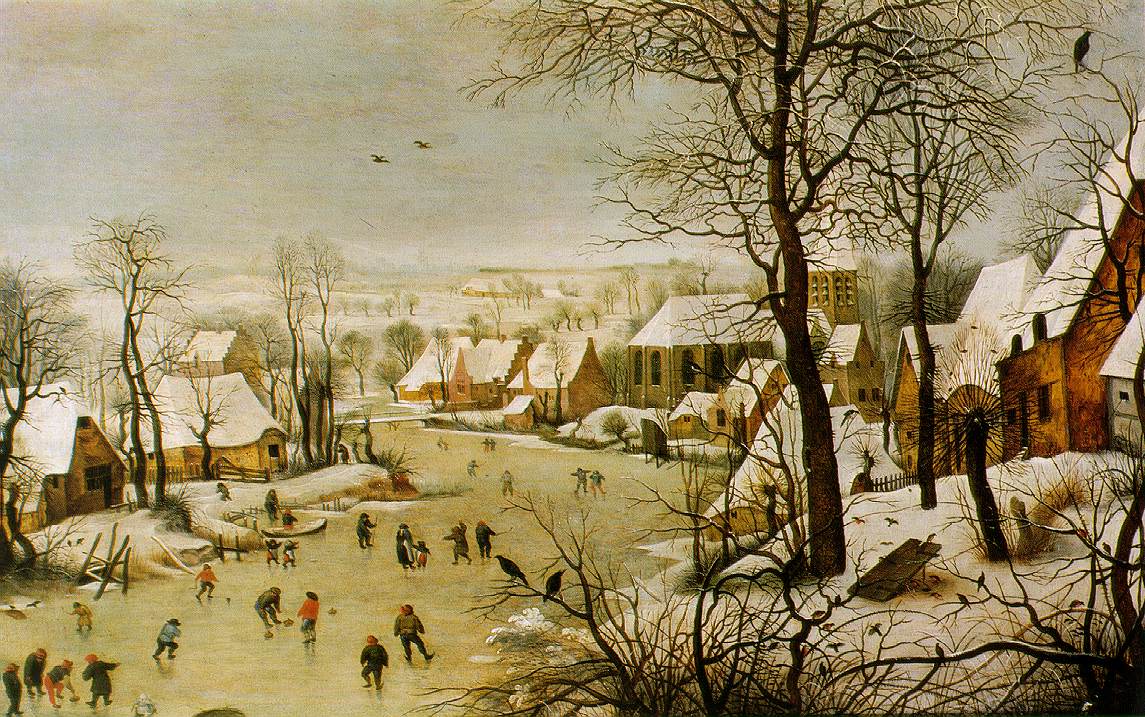
When the weather is cold, Swedes walk on the ice. It's like a scene out of Brueghel, sledders and skaters and skiers slipping and sliding and promenading, the steeples and towers of the city on the palisades of Lake Mälaren above and around them.
Me, I've taken a walk on the ice exactly once. And that was on a very shallow lake outside the city. I decided that I'm not so keen on any kind of exercise that requires a weird plastic necklace with detachable wooden handles that end in metal spikes that can quickly be whipped free and stabbed into the ice so one can pull oneself out of the freezing water. Swedes apparently learn how to use these things - called isdubbar - when they're in school, sort of like we had to learn lifesaving techniques in swimming class in high school. Somehow, having that thing around my neck takes away the feeling of calm that walking on the ice is supposed to give one.
Meanwhile, in South Africa, the husband arrived at his hotel only to find that someone had stolen the underwear out of his baggage while it was, uh, being handled. I wonder if the person who stole the underwear was disappointed that it was clean.
The Swedish word for the day is tjuv. It means thief.
- by Francis S.
Monday, January 13, 2003



Sunday, January 12, 2003
Last year, being relatively new to the blogosphere, and full of opinion and bite, I followed rather closely those awards known as the Bloggies and in response made my own awards - the My Way awards - with winners in categories such as Best Sylvia Plath impersonator, Best Potential Pornstar, Best i-Mom, Weakest Link, Best-in-Show, that kind of thing.
This year, I haven't been paying enough attention to make my own awards, let alone notice the Bloggies - but Jessica has. She made a list of recommended nominations for the Bloggies. And graciously, she nominated "How to learn Swedish in 1000 difficult lessons" in the Best European Blog category, among many other suggestions (including Miguel, whom I then went and voted for in several categories, along with voting for a number of other favorites on the links to the left).
The Swedish phrase for the day is tack ska du ha. It means, literally, thanks shall you have - I suppose a more useful translation might be thanks ever so kindly.
- by Francis S.

This year, I haven't been paying enough attention to make my own awards, let alone notice the Bloggies - but Jessica has. She made a list of recommended nominations for the Bloggies. And graciously, she nominated "How to learn Swedish in 1000 difficult lessons" in the Best European Blog category, among many other suggestions (including Miguel, whom I then went and voted for in several categories, along with voting for a number of other favorites on the links to the left).
The Swedish phrase for the day is tack ska du ha. It means, literally, thanks shall you have - I suppose a more useful translation might be thanks ever so kindly.
- by Francis S.
Saturday, January 11, 2003
The Baltic is frozen to the edges of the Stockholm archipelago, and the sun has finally made it over the horizon for the first time in a month in the northern Swedish city of Kiruna. But the husband has momentarily abandoned the winter for sun and heat. He is, as I write this, on his way to South Africa to film a music video involving a rabbitman and a band playing on the flatbed railroad car of a train careening through the countryside of South Africa.
The South African publicist and his husband, the guy from the Goethe Institute, were terribly jealous when the husband told them earlier in the week. They'd stopped by to pick up shoes that they'd left behind at the New Year's party and brought sherry, which we sat sipping in what was nearly a caricature of civilized fashion.
"Did you have fun at the party?" the husband asked. They had hardly known anyone but us.
"Yes, we had fun," said the South African publicist, despite his having to perform his usual party trick of speaking Xhosa, with its clicks and stops. "But stop trying to change the subject. I can't believe you're going to South Africa. Don't you need an assistant?"
Unfortunately, my husband did not need an assistant.
The Swedish word for the day is resenär. It means traveller.
- by Francis S.
The South African publicist and his husband, the guy from the Goethe Institute, were terribly jealous when the husband told them earlier in the week. They'd stopped by to pick up shoes that they'd left behind at the New Year's party and brought sherry, which we sat sipping in what was nearly a caricature of civilized fashion.
"Did you have fun at the party?" the husband asked. They had hardly known anyone but us.
"Yes, we had fun," said the South African publicist, despite his having to perform his usual party trick of speaking Xhosa, with its clicks and stops. "But stop trying to change the subject. I can't believe you're going to South Africa. Don't you need an assistant?"
Unfortunately, my husband did not need an assistant.
The Swedish word for the day is resenär. It means traveller.
- by Francis S.
Tuesday, January 7, 2003
Who says that consumers want mobile phones (sorry, link in Swedish only and even worse, no pictures) only for talking?
Some people obviously like to use the take-a-picture functions available on the latest models. Like the guy who bought a phone here in Sweden and found it pre-loaded with pictures that hadn't been removed when it had been returned by its previous owner. Strangely enough, the pictures were of the previous owner's dick.
Sadly, I don't think this is going to happen to me when I get a phone to replace the one that died over the holidays.
The Swedish word for the day is, uh, kuk, which is pronounced sort of like "cuke" and means cock, and should not be confused with kock, which is pronounced sort of like "kook" and means cook or chef.
- by Francis S.
Some people obviously like to use the take-a-picture functions available on the latest models. Like the guy who bought a phone here in Sweden and found it pre-loaded with pictures that hadn't been removed when it had been returned by its previous owner. Strangely enough, the pictures were of the previous owner's dick.
Sadly, I don't think this is going to happen to me when I get a phone to replace the one that died over the holidays.
The Swedish word for the day is, uh, kuk, which is pronounced sort of like "cuke" and means cock, and should not be confused with kock, which is pronounced sort of like "kook" and means cook or chef.
- by Francis S.
Sweden is Babyland.
Yeah, people are, arguably, babied a bit by the government, which many Swedes will readily tell you (a big controversy at the moment are the high numbers of people on, er, "disability" - sjukskriven they call it - because their doctors have written them notes to bring to their bosses saying they have a tummyache and it's going to last two months so they have to stay home and drink flat gingerale. Or something like that.)
But I was thinking of Sweden as Babyland more because there seems to be a baby boom going on. The government encourages babying on many levels, apparently. For instance, parents get some $100 per month per child from the government to cover the cost of raising a child. Parents also get nearly a year and a half of parental leave when a child is born, to be divided as they wish, much of that time at 80 percent pay. There is special sick leave when a parent must stay home to take care of a child, and there is universal daycare. The country is a veritable Parentopia.
I want to have a child.
(I think the fact that all my friends are having babies is having an effect on me. After all, who could resist the charms of, say, Hannes Pakarinen, who on New Year's played the part of The Perfect Baby - those cheeks! that nose! those little rabbit booties!)
Am I crazy?
The Swedish phrase for the day is vad har hänt? It means what has happened?
by Francis S.
Yeah, people are, arguably, babied a bit by the government, which many Swedes will readily tell you (a big controversy at the moment are the high numbers of people on, er, "disability" - sjukskriven they call it - because their doctors have written them notes to bring to their bosses saying they have a tummyache and it's going to last two months so they have to stay home and drink flat gingerale. Or something like that.)
But I was thinking of Sweden as Babyland more because there seems to be a baby boom going on. The government encourages babying on many levels, apparently. For instance, parents get some $100 per month per child from the government to cover the cost of raising a child. Parents also get nearly a year and a half of parental leave when a child is born, to be divided as they wish, much of that time at 80 percent pay. There is special sick leave when a parent must stay home to take care of a child, and there is universal daycare. The country is a veritable Parentopia.
I want to have a child.
(I think the fact that all my friends are having babies is having an effect on me. After all, who could resist the charms of, say, Hannes Pakarinen, who on New Year's played the part of The Perfect Baby - those cheeks! that nose! those little rabbit booties!)
Am I crazy?
The Swedish phrase for the day is vad har hänt? It means what has happened?
by Francis S.
Monday, January 6, 2003
The American editor and his wife left this morning, piling bag after bag into the cab as if they were fleeing the country. The apartment is empty and a little cold in the pale January light. Oh, the dinners and parties and games and movies and conversations and more conversations of the past three weeks - I've been so busy living, I haven't had the time to write about it.
The Swedish phrase for the day is på grund av, often shortened to the acronym p g a. It means on account of.
by Francis S.
The Swedish phrase for the day is på grund av, often shortened to the acronym p g a. It means on account of.
by Francis S.
Thursday, January 2, 2003
I've made it three-quarters of the way through to the twelfth day of Christmas, which is an amazing feat. The season has been unduly full of cookie baking, concert singing, movie going, IKEA shopping, American Christmas dinner for 15 Swedes fixing, and then guests, guests and more guests, including my sister-in-law, the rebel, who was here for 18 hours before she whizzed off back to the States at 9 a.m. on Dec. 31.
Then there was that New Year's party we gave. At 8:00 a.m., instead of leaving, the last guests were given sheets and pillows to sleep on the sofas in the living room.
Someone left his or her digital camera complete with, er, interesting pictures of the football player in what could be described as an unusual yoga position. The photos could no doubt have been sold to Hänt Extra, Sweden's smarmy equivalent to The National Enquirer, for good money.
It's been a day and a half and I still feel like I could sleep for a week. But that's the mark of a good party, isn't it?
The Swedish word for the day is januari, which you don't need me to tell you means January.
by Francis S.
Then there was that New Year's party we gave. At 8:00 a.m., instead of leaving, the last guests were given sheets and pillows to sleep on the sofas in the living room.
Someone left his or her digital camera complete with, er, interesting pictures of the football player in what could be described as an unusual yoga position. The photos could no doubt have been sold to Hänt Extra, Sweden's smarmy equivalent to The National Enquirer, for good money.
It's been a day and a half and I still feel like I could sleep for a week. But that's the mark of a good party, isn't it?
The Swedish word for the day is januari, which you don't need me to tell you means January.
by Francis S.
Subscribe to:
Posts (Atom)